Gym Bench & Squat Rack






Heavy-Gauge Steel Construction and Maximum User Load Ratings for Indian Home Gyms
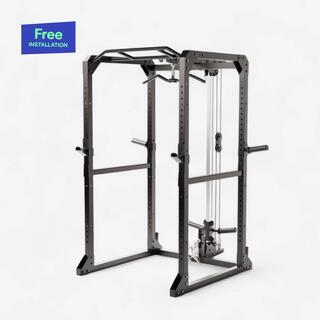
Gym bench squat racks engineered for Indian apartment and home gym environments must meet strict structural load tolerances. Domyos squat racks utilize heavy-gauge tubular steel construction with wall thicknesses ranging from 2.0mm to 3.0mm, delivering maximum user load ratings between 150kg and 250kg depending on the model. These load ratings account for combined user bodyweight plus barbell and plate loads during compound lifts. The rectangular or square tube profiles provide superior torsional rigidity compared to round tubing, preventing lateral sway during heavy squats or overhead press movements.
Welded joints undergo stress testing to ensure structural integrity under repeated loading cycles. Indian buyers training in compact spaces benefit from bolt-together modular designs that allow disassembly for relocation without compromising frame stability. Powder-coated finishes resist humidity corrosion in monsoon climates, while rubber foot pads protect tile and laminate flooring common in urban apartments. Adjustable J-hook positions accommodate varying user heights and exercise variations, with safety spotter arms providing fail-safe catch points positioned 50mm to 100mm below bar path trajectories.
Adjustable Height Configurations and Multi-Position J-Hooks for Compound Movement Versatility
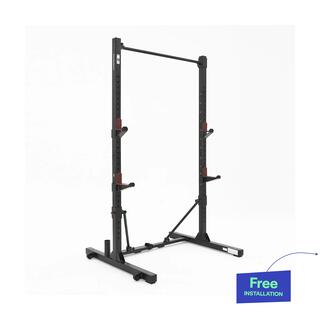
Effective squat rack systems feature multi-position J-hook adjustment mechanisms with vertical spacing intervals of 50mm to 75mm. This granular height control allows precise bar positioning for back squats, front squats, overhead press, and bench press variations. Domyos racks incorporate pin-and-hole adjustment systems where hardened steel pins lock into laser-cut holes, eliminating slippage under load. The J-hook cradle depth typically measures 80mm to 120mm, providing secure bar seating while allowing smooth lift-off during eccentric and concentric phases.
Safety spotter arms extend horizontally 300mm to 500mm from the vertical uprights, creating a protective cage around the lifter. These arms adjust independently from the J-hooks, allowing customized safety positioning based on exercise depth and user anthropometry. Indian lifters performing deep squats below parallel benefit from lower spotter arm settings, while partial range movements require higher positioning. Rubber or UHMW plastic contact surfaces on J-hooks and spotter arms prevent barbell knurling damage and reduce metal-on-metal noise in shared living spaces.
Integrated Bench Systems with Decline, Flat, and Incline Angle Adjustments
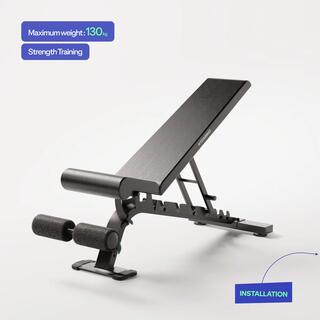
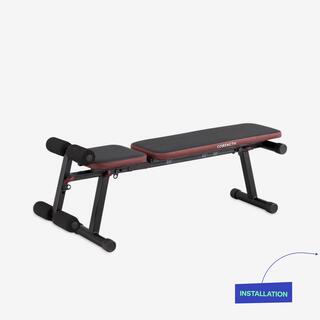
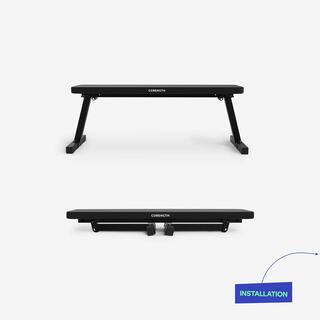
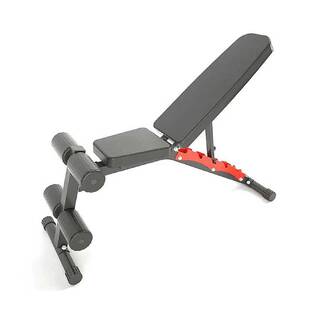
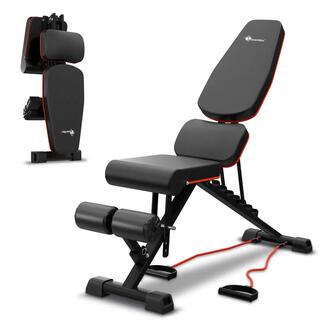
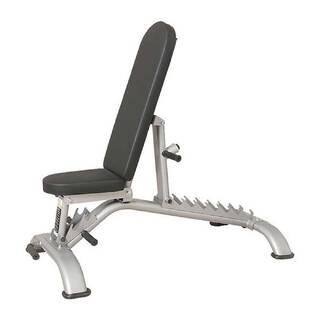
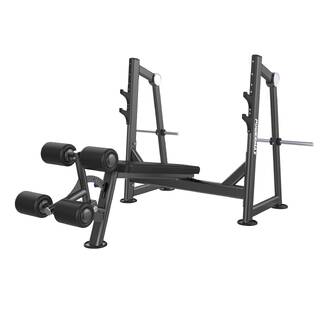
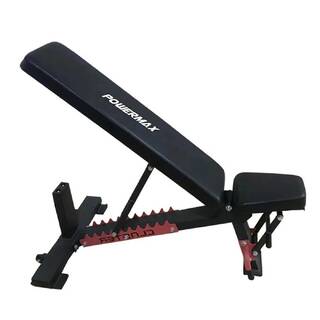
Combination bench and squat rack units maximize training versatility within limited floor footprints. Domyos integrated systems feature adjustable benches with decline angles of negative 15 to 20 degrees, flat positioning at zero degrees, and incline angles ranging from 30 to 85 degrees. The bench frame connects to the rack structure through bolt-secured attachment points, ensuring stability during heavy pressing movements. Upholstered pads utilize high-density foam cores between 40mm and 60mm thickness, covered in vinyl or synthetic leather that resists sweat absorption and bacterial growth in humid conditions.
Leg developer attachments accommodate quad extensions and hamstring curls, with pivoting ankle roller pads adjusting to accommodate different leg lengths. The bench width typically measures 280mm to 320mm, providing stable shoulder blade contact without restricting natural scapular movement during pressing exercises. Transport wheels or handles facilitate repositioning within training spaces, while fold-flat designs reduce storage depth to under 400mm when not in use. Weight plate storage pegs integrated into rack uprights keep Olympic and standard plates organized at arm's reach, eliminating the need for separate storage trees.
Olympic Barbell Compatibility and Standard Sleeve Diameter Specifications
Squat rack J-hooks and safety arms must accommodate both Olympic barbells with 50mm sleeve diameters and standard barbells with 25mm to 28mm sleeve diameters. Olympic-compatible racks feature J-hook cradle widths of 55mm to 60mm, providing clearance for knurled grip sections without binding. The vertical upright spacing, measured center to center, typically ranges from 1000mm to 1200mm for squat racks, allowing sufficient clearance for shoulder-width squat stances while maintaining compact footprints suitable for 8x8 foot training areas common in Indian home gyms.
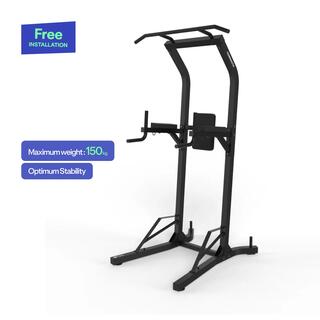
Pull-up bars integrated into rack structures support bodyweight exercises and resistance band training. These bars position at heights between 1900mm and 2200mm from floor level, accommodating users up to 190cm tall with full arm extension. Knurled or textured grip surfaces prevent hand slippage during high-repetition sets, while multi-grip configurations offer neutral, wide, and close hand positions. Plate-loaded lat pulldown and low row attachments convert basic racks into comprehensive strength stations, with pulley systems utilizing sealed bearing assemblies for smooth cable travel under loads up to 100kg.
Floor Protection Systems and Vibration Dampening for Apartment Training Environments
Indian home gym setups in multi-story buildings require vibration isolation to minimize noise transmission through concrete slab floors. Domyos squat racks incorporate large-diameter rubber foot pads measuring 80mm to 120mm across, distributing equipment weight over greater surface areas to reduce point loading on tiles and hardwood. Interlocking rubber floor mats with thicknesses from 10mm to 20mm provide additional shock absorption during barbell drops or plate changes, while protecting floor surfaces from scratches and dents.
The total footprint of combination bench and squat rack systems ranges from 1.2m x 1.5m for compact models to 1.8m x 2.2m for full power rack configurations. This spatial efficiency allows installation in spare bedrooms, balconies, or garage spaces without obstructing doorways or circulation paths. Modular designs permit future expansion with dip station attachments, landmine pivots, or resistance band anchor points. Regular maintenance involves checking bolt torque specifications every 30 training sessions and inspecting welds for stress cracks, particularly at high-load connection points between uprights and base frames.
Safety Certification Standards and Load Testing Protocols for Home Strength Equipment
Reliable squat rack systems undergo static and dynamic load testing to verify structural performance under real-world training conditions. Static tests apply 1.5 to 2.0 times the rated maximum load for sustained periods, ensuring frames do not deform or exhibit joint separation. Dynamic testing simulates repeated loading cycles equivalent to thousands of training sessions, identifying fatigue points in welds and fasteners. Domyos equipment meets European EN 957 safety standards for stationary training equipment, covering stability, structural strength, and user safety features.
Indian buyers should verify that J-hooks feature locking mechanisms or gravity-activated retention systems preventing accidental dislodgement during bar placement. Safety spotter arms must support sudden impact loads when catching failed lifts, requiring reinforced construction at pivot and mounting points. Instruction manuals specify proper anchoring methods for free-standing racks, including optional floor bolting for enhanced stability during explosive movements. Regular inspection of adjustment pins, looking for wear or deformation, ensures continued safe operation throughout the equipment's service life, typically rated for 10 to 15 years under normal residential use patterns.
FAQ (Frequently Asked Questions)
Q1. What maximum weight capacity should I look for in a squat rack for home use in India?
For home gym applications, select squat racks with maximum user load ratings between 200kg and 250kg, which accounts for your bodyweight plus barbell and plates. Domyos racks constructed from 2.5mm to 3.0mm wall thickness steel tubing provide adequate strength for intermediate to advanced lifters. Verify that both the J-hooks and safety spotter arms share the same load rating, as these components experience the highest stress during failed lifts or emergency bar drops.
Q2. Can I use a squat rack safely in an apartment without disturbing neighbors below?
Yes, with proper floor protection and controlled lifting technique. Install 15mm to 20mm thick interlocking rubber mats under the entire rack footprint to absorb vibration and impact noise. Choose racks with large rubber foot pads that distribute weight evenly across floor surfaces. Avoid dropping barbells from overhead positions, and use controlled eccentric movements during all exercises to minimize impact transmission through concrete slab floors common in Indian apartment buildings.
Q3. What is the difference between a squat rack and a power rack for home training?
Squat racks feature two vertical uprights with adjustable J-hooks and typically occupy 1.2m x 1.5m floor space, suitable for squats and bench press with a spotter. Power racks enclose the lifter within four uprights creating a safety cage, with adjustable spotter arms on all sides, requiring 1.8m x 2.2m footprint. Power racks allow solo training without a spotter since safety arms catch the bar from any direction, making them preferable for home gyms where you train alone.
Q4. How much ceiling height do I need to install a squat rack with pull-up bar?
Minimum ceiling height of 2400mm (8 feet) allows installation of standard squat racks with integrated pull-up bars positioned at 2100mm to 2200mm. This provides adequate clearance for users up to 185cm tall to perform full-range pull-ups. If your ceiling height is only 2300mm, consider racks without pull-up bars or models with removable top sections. Always measure your actual ceiling height and account for any ceiling fans or light fixtures before purchasing.
Q5. Do Domyos squat racks work with both Olympic and standard barbells?
Most Domyos squat racks accommodate Olympic barbells with 50mm diameter sleeves through J-hook cradles measuring 55mm to 60mm wide. Standard barbells with 25mm to 28mm sleeves also fit but may shift slightly within the wider cradles. For dedicated standard barbell use, look for racks with adjustable cradle inserts or choose models specifically designed for 28mm bars. Olympic compatibility provides greater versatility for future equipment upgrades.
Q6. How do I anchor a free-standing squat rack to prevent tipping during heavy lifts?
Free-standing racks achieve stability through wide base footprints and low center of gravity design, adequate for most home training. For additional security during heavy squats exceeding 150kg, bolt the rack base to concrete floors using M10 or M12 expansion anchors through pre-drilled holes in the foot plates. On tile floors where drilling is not possible, place the rack on 20mm rubber mats and position weight plate storage pegs low on the frame to add ballast weight.
Q7. What J-hook spacing interval is best for adjusting to different exercise heights?
J-hook adjustment holes spaced at 50mm to 75mm vertical intervals provide sufficient granularity for most users. Closer 50mm spacing allows finer height tuning for exercises like overhead press where small adjustments significantly affect starting position. Wider 75mm spacing is acceptable for squats where bar height is less critical. Domyos racks typically use 60mm spacing as an optimal compromise between adjustment precision and structural integrity of the upright tubes.
Q8. Can I perform bench press exercises safely on a squat rack without a spotter?
Yes, by positioning the safety spotter arms 50mm to 80mm below your chest at the bottom of the bench press movement. If you fail a rep, lower the bar to your chest and roll it down to your hips, then sit up. The spotter arms catch the bar before it pins you. Practice this safety technique with light weights first. For maximum safety during solo training, consider combination units with built-in bench frames that integrate directly with the rack structure.
Q9. How much space should I leave around a squat rack for safe training and plate loading?
Maintain 600mm to 800mm clearance on the sides for loading and unloading weight plates without hitting walls or furniture. Leave 1000mm clearance at the front and rear for walking around the rack and performing exercises with full range of motion. Total recommended training area is approximately 2.5m x 3.0m for basic squat racks, or 3.0m x 3.5m for power rack configurations with integrated benches and accessory attachments.
Q10. What maintenance does a home squat rack require in humid Indian climates?
Inspect all bolted connections monthly and retighten to specified torque values, as vibration from training loosens fasteners over time. Wipe down powder-coated surfaces weekly with a dry cloth to remove sweat and moisture that accelerates corrosion. Check adjustment pins and J-hooks for wear every three months, replacing any components showing deformation or cracks. Apply silicone spray to adjustment holes twice yearly to prevent rust in high-humidity environments, ensuring smooth height changes during workouts.