Skateboards, Longboards & Waveboards





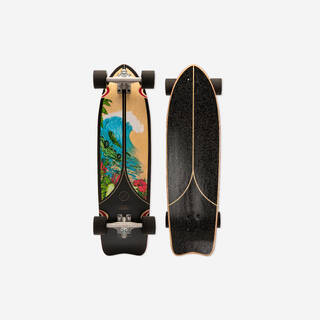


Deck Construction, Wheelbase Geometry, and Riding Stability for Indian Urban Terrain
Skateboard deck construction determines flex response, impact durability, and rider weight distribution across concrete surfaces. Standard street skateboards use 7-ply Canadian maple laminate with epoxy resin bonding, delivering stiff pop for ollies and kickflips on rough Indian pavements. Longboard decks extend from 33 to 46 inches in length, featuring 8 to 11-ply bamboo-maple hybrid construction for controlled flex under carving loads. Wheelbase geometry (the axle-to-axle truck spacing) directly governs turn radius and stability at speed. Shorter wheelbases (14 to 18 inches) enable tight urban maneuvers, while extended wheelbases (24 to 32 inches) provide high-speed stability for downhill runs and campus commutes.
Deck concave profiles (the lateral curvature across the width) range from flat (0mm rise) for cruising comfort to aggressive W-concave (12mm rise) for locked-in foot pockets during slides. Kicktail angles (the upward curve at deck ends) vary from mellow 15-degree cruiser tails to steep 25-degree street tails for manual balance and pivot tricks. Indian riders navigating potholed roads and uneven footpaths require decks with reinforced nose and tail construction, often integrating fiberglass layers or carbon fiber stringers to resist stress fractures. Grip tape grit ratings (40 to 80 grit silicon carbide) ensure foot traction during monsoon humidity and dust accumulation, with coarser grits offering superior grip for technical street skating.
Waveboard decks employ torsion bar suspension systems connecting two independent platforms, allowing 360-degree caster wheel rotation for propulsion without ground pushing. The central torsion spring stiffness (measured in Newtons per millimeter) dictates carving responsiveness and rider input sensitivity. Stiffer springs suit heavier riders and aggressive carving, while softer springs accommodate beginners learning body-weight transfer mechanics. Deck platform width (typically 6 to 8 inches per side) affects stance stability and leverage over the caster mechanism, with wider platforms reducing learning curve difficulty for young riders adapting to the unique propulsion method.
Truck Geometry, Bushing Durometer, and Axle Width for Carving Control
Skateboard trucks mount to the deck via four bolts per truck, with hanger width (the axle span) matching deck width for optimal wheel clearance and turning leverage. Standard street trucks range from 129mm to 149mm hanger width, suited for decks between 7.5 and 8.5 inches wide. Longboard trucks extend from 150mm to 180mm for wider decks, with reverse kingpin (RKP) geometry replacing traditional kingpin (TKP) designs. RKP trucks position the kingpin behind the axle, lowering the center of gravity and increasing carving angle responsiveness for downhill stability and smooth pumping on flat ground.
Bushing durometer (the hardness rating of polyurethane cushions) controls truck lean resistance and return-to-center spring. Soft bushings (78A to 87A durometer) compress easily under rider weight, enabling deep carves and fluid turns for cruising and commuting. Hard bushings (90A to 95A durometer) resist compression, delivering stable high-speed tracking and reduced speed wobble during downhill runs. Cone-shaped bushings (roadside position) allow greater lean angles, while barrel-shaped bushings (boardside position) provide progressive resistance throughout the turn arc. Indian riders frequently upgrade stock bushings to match their weight and riding style, with heavier riders (over 75kg) requiring harder durometers to prevent truck bottoming and wheel bite.
Truck baseplate angles (the mounting surface tilt relative to the ground) range from 44 degrees for stable downhill tracking to 50 degrees for responsive street carving. Lower baseplate angles reduce turn initiation sensitivity, ideal for maintaining straight-line control at speeds exceeding 30 km/h on campus roads or ghat descents. Split-angle truck setups (combining different baseplate angles front and rear) enhance directional stability while preserving front-end maneuverability, a configuration favored for freeride sliding and technical downhill navigation through Indian hill station switchbacks.
Wheel Durometer, Contact Patch Width, and Urethane Rebound for Surface Grip
Skateboard wheel durometer determines grip levels, roll speed, and vibration damping across varied pavement textures. Hard wheels (99A to 101A durometer) minimize rolling resistance on smooth surfaces, delivering fast acceleration and reduced friction for street tricks and skatepark transitions. Soft wheels (78A to 87A durometer) compress against rough asphalt and concrete irregularities, absorbing impact shocks and maintaining traction during cornering loads. Indian urban environments with cracked pavements, speed breakers, and gravel patches demand softer durometers (80A to 85A) for comfortable cruising and reduced rider fatigue over extended commutes.
Wheel diameter directly affects acceleration response and obstacle clearance. Small wheels (50mm to 54mm) accelerate quickly and fit tight truck clearances for technical street skating, but struggle with pebbles and pavement cracks. Large wheels (60mm to 75mm for longboards) maintain momentum efficiently, roll over debris smoothly, and provide higher top speeds for distance pushing and downhill runs. Contact patch width (the wheel surface touching the ground) ranges from narrow 30mm racing profiles for reduced friction to wide 50mm freeride profiles for maximum grip during pre-drift initiation and controlled slides.
Urethane rebound percentage (the energy return after compression) governs roll efficiency and speed maintenance. High-rebound formulas (85% to 95% rebound) convert compression energy back into forward motion, ideal for long-distance pushing and maintaining speed through carves. Lower-rebound formulas sacrifice some roll speed for predictable slide initiation, allowing riders to break traction controllably during downhill speed checks. Core construction (the inner hub material) varies from solid urethane for cruiser wheels to reinforced plastic cores for downhill wheels, reducing rotational mass while maintaining structural integrity under lateral slide forces exceeding 1.5 times rider weight during hard carves.
ABEC Bearing Ratings, Sealed Cartridge Designs, and Monsoon Corrosion Resistance
Skateboard bearings use the ABEC precision rating system (ranging from ABEC-1 to ABEC-9) to classify manufacturing tolerances and internal clearances. Higher ABEC ratings indicate tighter tolerances, theoretically enabling higher rotational speeds with reduced friction. However, ABEC ratings measure precision, not durability or load capacity. ABEC-5 and ABEC-7 bearings provide sufficient speed for most skating applications, while ABEC-9 bearings offer marginal performance gains only noticeable during sustained high-speed runs exceeding 40 km/h. Indian riders prioritize bearing seal integrity and corrosion resistance over maximum ABEC ratings due to monsoon moisture exposure and dusty conditions.
Bearing seal designs determine contamination protection and lubrication retention. Open bearings (no shields) offer minimal friction but rapidly accumulate dust and moisture, requiring frequent cleaning and re-lubrication. Single-shielded bearings (metal or rubber shield on one side) balance protection with moderate maintenance intervals. Double-shielded or sealed bearings (shields on both sides) provide maximum contamination resistance, essential for riding through monsoon puddles and humid coastal environments. Ceramic ball bearings (silicon nitride instead of steel) resist corrosion and reduce rotational friction, though their performance advantage remains minimal for recreational skating compared to quality steel bearings with proper sealing.
Bearing spacers (cylindrical sleeves fitting between bearings inside the wheel core) prevent lateral bearing misalignment when tightening axle nuts, distributing clamping loads evenly across both bearings. Without spacers, overtightening compresses the inner bearing race, increasing friction and reducing roll speed. Built-in bearing spacers (integrated into wheel cores) eliminate the need for separate spacers, simplifying wheel installation and ensuring consistent bearing alignment. Speed rings (thin washers positioned between bearings and truck faces) reduce friction between rotating wheels and stationary axle nuts, particularly important during long pushing sessions where cumulative friction losses impact overall efficiency.
Oxelo Complete Skateboards, Component Upgradeability, and Beginner Progression Paths
Oxelo designs complete skateboard, longboard, and waveboard systems for riders progressing from initial balance acquisition to intermediate trick execution and distance cruising. Complete setups eliminate component compatibility guesswork, pairing matched deck widths with appropriate truck hangers, wheel durometers, and bearing ratings. Entry-level complete skateboards feature 7-ply maple decks (31 to 32 inches long, 7.75 to 8 inches wide) with medium concave profiles, 52mm wheels at 90A durometer, and ABEC-5 bearings. This configuration balances street trick capability with enough wheel softness for navigating Indian footpath irregularities and campus roads.
Longboard completes span cruiser, carving, and freeride disciplines. Cruiser completes (33 to 38 inches) mount soft 65mm wheels (78A durometer) on reverse kingpin trucks with loose bushing setups, optimized for relaxed pushing and mellow carving on evening beach promenades or park paths. Carving completes (38 to 42 inches) feature pintail or drop-through deck shapes with flexible bamboo-maple construction, enabling deep turn arcs and pumping propulsion without foot pushing. Freeride completes (38 to 42 inches) use symmetrical twin-tip decks with moderate concave, harder 70mm wheels (83A durometer), and split-angle truck setups for controlled sliding and downhill speed management on ghat roads.
Component upgradeability allows riders to refine complete setups as skills progress. Beginner riders often upgrade bushings first, selecting durometers matching their weight for improved turn control without replacing entire trucks. Wheel upgrades address specific terrain needs, swapping harder wheels for skatepark sessions or softer wheels for rough commute routes. Bearing upgrades focus on sealed designs rather than chasing higher ABEC ratings, prioritizing longevity in humid conditions. Deck replacements become necessary after stress cracks appear near truck mounting holes or when riders outgrow initial size selections, typically upgrading to wider decks (8.25 to 8.5 inches) for increased stability during transition skating or technical street lines.
Waveboard Propulsion Mechanics, Caster Wheel Angles, and Indoor Practice Adaptation
Waveboard propulsion relies on alternating body weight shifts across the torsion bar centerline, generating forward momentum through coordinated hip rotation and foot pressure modulation. Unlike traditional skateboards requiring ground pushing, waveboards convert lateral carving motion into directional travel through 360-degree rotating caster wheels. Each platform mounts a single caster wheel at approximately 30 degrees from vertical, allowing simultaneous steering and propulsion. Riders initiate movement by twisting hips and shoulders in opposition, transferring energy through the torsion spring into rotational wheel force that propels the board forward.
Caster wheel diameter and durometer affect acceleration responsiveness and surface compatibility. Smaller 76mm caster wheels accelerate quickly and fit compact indoor spaces, ideal for apartment hallway practice and building fundamental carving rhythm. Larger 80mm wheels maintain momentum more efficiently outdoors, rolling over small debris and pavement imperfections common on Indian residential streets. Wheel durometer selection (typically 82A to 88A) balances grip for outdoor asphalt traction with sufficient hardness for smooth indoor tile or concrete surfaces. Softer outdoor wheels may mark polished floors, requiring riders to dedicate separate wheel sets for indoor versus outdoor sessions.
Torsion bar spring tension adjustability allows customization for different rider weights and skill levels. Beginners benefit from looser spring tension, reducing the force required to initiate carving motion and allowing gradual adaptation to the unique balance demands. Advanced riders tighten springs for more aggressive carving response and higher energy return during powerful pumping sequences. Deck platform grip tape patterns (often featuring raised textures or geometric cutouts) provide visual foot placement references and tactile feedback, helping riders maintain centered stance over each caster wheel for balanced propulsion force distribution. Indian riders practicing in limited indoor spaces appreciate waveboards' stationary carving capability, building core strength and coordination without requiring long straight runs for traditional skateboard pushing.
FAQ (Frequently Asked Questions)
Q1. What width skateboard should I buy, I’m 18 years old
Q2. I’m starting new in skateboarding, what type of board will be best?
Q3. Can I get best good quality skateboards in India?
Yes for sure. You can check out Decathlon’s website for this. We have a lot of diversity in terms of options within this category. Happy shopping!
Q4. What is the perfect dimension and weight of the waveboard for beginners?
21.5-inch x 76 inches and 2.4 Kg
Q5. Is there any warranty on the waveboards?
2 years warranty is offered on all waveboards available on the Decathlon platform.
Q6. Which waveboards are best for beginners?
Oxelo waveboard is best for beginners as it is easy to control and one can learn within two or three weeks on the same. It is good for both beginners as well as experts.
Q7. How much weight can a waveboard take?
Waveboards have the ability to hold weight up to 100 kg. However, it also depends on the wheels of the waveboard, which contribute to high performance if they are made of durable material.
Q8. Is the waveboard safe?
Yes, they are completely safe if used properly. The safety completely depends on the users. Be it skateboard or waveboard, skating should be done by wearing helmets, and padding. Skating on roads is strictly prohibited unless you are an advanced skater who can take care of himself/herself.
Q9. What skateboard deck width should I choose as a beginner learning tricks on Indian streets?
Beginners learning street tricks should start with 7.75 to 8 inch wide decks, providing stable footing for landing ollies and kickflips while remaining narrow enough for flip trick control. Wider decks (8.25 to 8.5 inches) suit riders prioritizing stability on rough Indian pavements or transitioning to ramp skating. Your shoe size also guides selection, with shoe sizes above UK 9 typically pairing better with 8 inch or wider decks for comfortable stance width.
Q10. How do longboard wheel durometers affect riding comfort on cracked Indian roads?
Softer longboard wheels (78A to 83A durometer) compress against pavement cracks and speed breakers, absorbing vibrations and maintaining smooth roll over rough surfaces common on Indian urban roads. Harder wheels (85A to 87A) roll faster on smooth pavement but transmit more impact shock through the deck, causing foot fatigue during long commutes. For mixed-condition riding across potholed streets and occasional smooth stretches, 80A to 83A durometer provides the best balance of comfort and speed retention.
Q11. Can I use the same skateboard for both street tricks and daily college commuting?
Street skateboards with hard wheels (99A to 101A durometer) excel at tricks but deliver harsh rides over rough commute routes, causing significant vibration fatigue. Swapping to softer wheels (87A to 92A durometer) transforms a trick board into a more comfortable cruiser while sacrificing some pop responsiveness and slide control. Many riders maintain two wheel sets, installing hard wheels for skatepark sessions and soft wheels for daily transportation, requiring only five minutes for a complete wheel swap using a skate tool.
Q12. What bearing maintenance schedule prevents rust during monsoon season?
Clean and re-lubricate bearings every two to three weeks during active monsoon exposure, or immediately after riding through standing water. Remove bearings from wheels, soak in isopropyl alcohol or citrus degreaser to dissolve contaminated lubricant, dry completely with compressed air or lint-free cloth, then apply two drops of skateboard-specific bearing oil or light machine oil to each bearing. Sealed or double-shielded bearings extend maintenance intervals to four to six weeks in humid conditions compared to open bearings requiring weekly attention.
Q13. How does reverse kingpin truck geometry improve longboard stability compared to standard trucks?
Reverse kingpin (RKP) trucks position the kingpin pivot behind the axle, creating a lower center of gravity and wider turning arc compared to traditional kingpin (TKP) trucks. This geometry increases stability at speeds above 25 km/h, reduces speed wobble during downhill runs, and enables smoother carving with less effort. RKP trucks also allow deeper lean angles before wheel bite occurs, making them superior for longboard cruising and downhill riding, while TKP trucks remain preferable for technical street skating requiring quick, tight turns.
Q14. What wheelbase length works best for navigating crowded Indian footpaths versus open roads?
Short wheelbases (14 to 18 inches on skateboards, 24 to 28 inches on longboards) enable tight turning radius for weaving through pedestrian traffic and navigating narrow footpaths. Long wheelbases (30 to 34 inches on longboards) provide straight-line stability for open road cruising and downhill runs but require wider turning space. Urban riders frequently choose mid-length wheelbases (26 to 30 inches) offering acceptable maneuverability in tight spaces while maintaining enough stability for faster road sections during mixed-environment commutes.
Q15. Do ABEC-9 bearings significantly improve skateboard speed compared to ABEC-5 for casual riding?
ABEC-9 bearings provide minimal noticeable speed advantage over ABEC-5 for casual riding and commuting at typical speeds below 25 km/h. The tighter tolerances of ABEC-9 only become relevant during sustained high-speed runs exceeding 40 km/h, where reduced internal friction marginally extends coasting distance. For Indian riding conditions involving frequent stops, rough pavement, and moderate speeds, investing in quality sealed ABEC-5 or ABEC-7 bearings with superior corrosion resistance delivers better long-term performance than open ABEC-9 bearings requiring constant maintenance.
Q16. How do I prevent wheel bite when installing larger wheels on my skateboard?
Prevent wheel bite by installing riser pads (6mm to 12mm thick rubber or plastic spacers) between deck and trucks, increasing ground clearance for larger wheels. Alternatively, tighten truck bushings to reduce maximum lean angle, though this also decreases turning responsiveness. Ensure wheel diameter and truck width compatibility, as wider trucks position wheels farther from the deck. Most street decks accommodate up to 54mm wheels without risers, while larger wheels (56mm and above) typically require at least 6mm risers to prevent contact during hard turns.
Q17. What deck flex rating suits heavier riders above 80kg for longboard cruising?
Heavier riders above 80kg require stiffer deck flex ratings to prevent excessive board sagging and maintain efficient energy transfer during pushing and carving. Look for decks rated for rider weights up to 100kg or 110kg, typically featuring 9-ply construction or bamboo-maple hybrid layups with reduced flex. Overly flexible decks under heavy riders bottom out during turns, causing wheel bite and unstable handling. Stiffer decks also improve pushing efficiency by minimizing energy loss to deck deflection, particularly important during long-distance commutes or uphill sections.
Q18. Can waveboards be used effectively on rough outdoor surfaces or only smooth indoor floors?
Waveboards perform best on smooth surfaces like indoor tiles, polished concrete, or well-maintained asphalt where caster wheels maintain consistent ground contact for efficient propulsion. Rough outdoor surfaces with gravel, cracks, or significant texture disrupt the continuous carving motion required for waveboard propulsion, causing frequent stalling and reduced control. Riders can use waveboards outdoors on smooth basketball courts, covered parking areas, or freshly paved roads, but should avoid heavily textured or debris-covered surfaces that compromise the small caster wheels' rolling efficiency and directional stability.