Resistance Bands



Latex vs TPE Resistance Bands: Material Density, Elastic Modulus, and Durability Under High-Humidity Conditions
Resistance bands fall into two core material families: natural latex rubber and thermoplastic elastomer (TPE). Natural latex delivers superior elastic modulus, meaning it returns to original length faster after stretch cycles. This property translates to consistent tension across the full range of motion, critical for controlled eccentric loading during glute bridges or banded deadlifts. Latex bands typically offer 500 to 800 percent elongation before failure, making them ideal for heavy resistance training where bands are stretched beyond double their resting length. However, latex degrades faster in high-humidity environments common across coastal and monsoon-heavy regions of India. Exposure to sweat salts and UV light accelerates polymer breakdown, reducing lifespan to 12 to 18 months under frequent use.
TPE bands trade some elastic snap for improved environmental stability. TPE resists UV degradation and maintains tensile strength in humid conditions, extending usable life to 24 months or more. The material feels smoother against skin, reducing friction burns during high-rep shoulder mobility drills or banded push-ups. TPE also eliminates latex allergy concerns, a consideration for approximately 1 to 2 percent of gym users. However, TPE exhibits slightly higher hysteresis (energy loss during stretch-release cycles), meaning the band feels marginally less responsive during explosive movements like banded box jumps or resisted sprints. For home gym setups in Mumbai, Kolkata, or Chennai where monsoon humidity peaks above 85 percent, TPE offers better long-term value. For competitive strength athletes prioritizing maximum tension consistency, latex remains the engineering standard.
Resistance Band Tension Ratings: Decoding Kilogram Load Curves and Selecting Appropriate Resistance for Progressive Overload
Resistance bands do not provide fixed load like iron plates. Tension increases linearly with elongation, following Hooke's Law principles. A band rated at 15 kg typically delivers that peak resistance only when stretched to 200 percent of resting length. At 150 percent elongation, the same band may provide only 10 to 11 kg of tension. This variable resistance profile makes band selection more nuanced than choosing a dumbbell weight. For beginners starting with bodyweight assistance exercises like banded pull-ups or inverted rows, light bands (5 to 10 kg at full stretch) allow proper form development without overwhelming grip strength or shoulder stabilizers.
Intermediate lifters targeting hypertrophy in glutes, hamstrings, and posterior chain muscles require medium to heavy bands (15 to 25 kg). These tension levels match the force output needed for banded Romanian deadlifts, hip thrusts, or lateral walks that fatigue muscle fibers within 12 to 15 reps. Advanced strength athletes often stack multiple bands or use extra-heavy single bands (30 to 50 kg) for accommodating resistance during barbell squats or bench press. The ascending resistance curve complements natural strength curves, providing maximum load at the top of the lift where mechanical advantage is greatest. For Indian apartment gym setups with limited floor space, a set of three to four bands spanning light to heavy resistance covers the full training spectrum from mobility warm-ups to maximal effort compound movements.
Loop Bands vs Tube Bands with Handles: Biomechanical Applications and Anchor Point Versatility
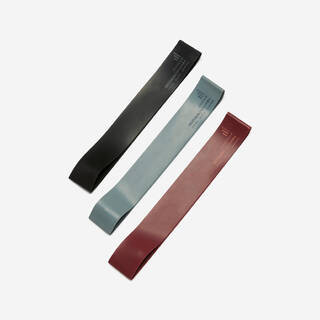
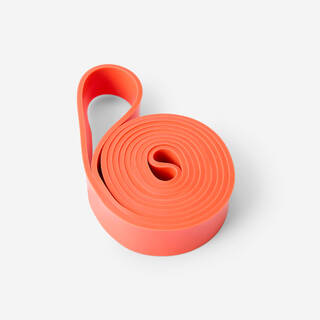
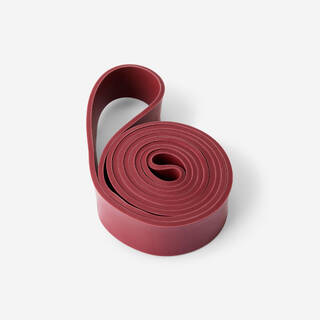
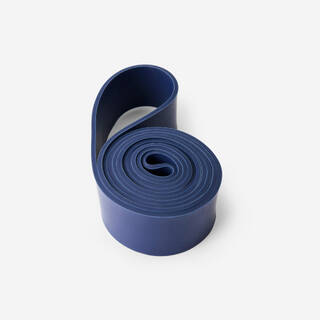
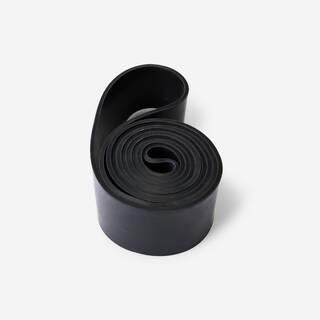
Loop bands (continuous closed circles) excel in lower body training where the band wraps around thighs, ankles, or feet. The seamless construction eliminates weak points found in handle attachment zones, allowing safe use at higher tensions. Loop bands enable exercises like monster walks, clamshells, and banded squats where the band must maintain position under friction against skin or fabric. Width matters significantly here. Narrow loops (2.5 to 5 cm) concentrate pressure, suitable for ankle work but uncomfortable around thighs during high-rep sets. Wide mini loops (7.5 to 10 cm) distribute load across more surface area, reducing skin irritation during glute activation circuits that may involve 50 to 100 reps per session.
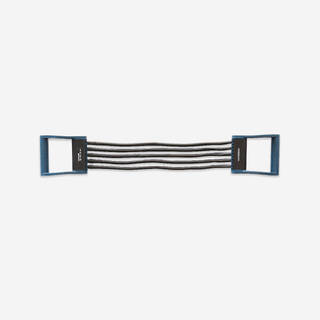
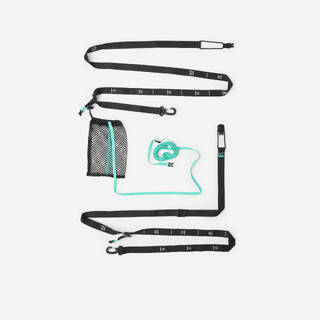
Tube bands with detachable handles provide superior versatility for upper body pressing, pulling, and rotational movements. Handles allow grip positions that mimic dumbbells or cable machines, making exercises like chest flyes, bicep curls, or woodchops feel more natural. Quality tube bands feature reinforced nylon sleeves covering the latex core near handle attachment points, preventing catastrophic failure during maximum tension pulls. Door anchors expand exercise libraries dramatically, converting any doorframe into a functional cable station for face pulls, tricep extensions, or standing chest presses. For Indian homes where drilling wall mounts is impractical, door anchors offer non-permanent installation. However, door thickness and frame stability must support the forces involved. A 20 kg band stretched to full tension can generate 150 to 200 Newtons of force, enough to damage hollow-core doors or loose frames.
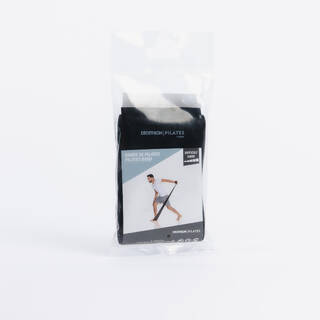
Domyos Resistance Band Engineering: Fabric-Reinforced Construction and Integrated Resistance Labeling Systems
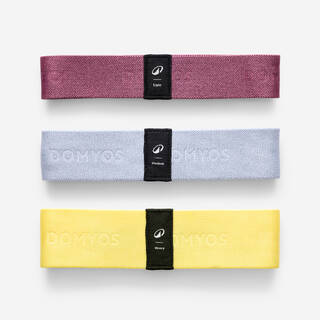
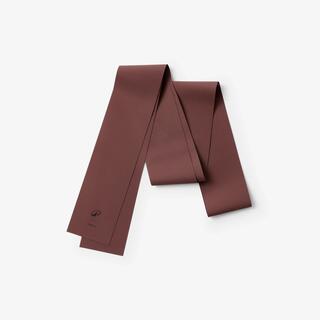
Domyos resistance bands incorporate fabric reinforcement layers that serve dual functions. The woven polyester or nylon sheath protects the inner latex or TPE core from abrasion during floor contact, a common failure mode when bands are anchored under feet or dragged across concrete home gym floors. This textile layer also provides a non-slip grip surface, critical during sweaty hands workouts in non-air-conditioned Indian home gyms where ambient temperatures reach 35 to 40 degrees Celsius during summer months. The fabric sheath increases overall band thickness by 1 to 2 mm, which slightly reduces maximum elongation percentage but dramatically extends service life by preventing micro-tears in the elastic core.
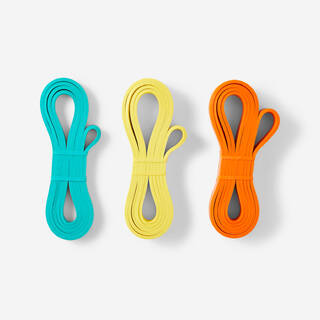
Color-coded resistance labeling on Domyos bands follows a standardized progression system. Light resistance bands (yellow or green) typically range from 5 to 10 kg, medium bands (blue or red) span 10 to 20 kg, and heavy bands (black or purple) deliver 20 to 35 kg at full extension. This visual system eliminates guesswork during circuit training or group fitness classes where quick band swaps are necessary. Domyos loop bands also feature printed elongation markers at 50 cm intervals, allowing users to track stretch distance and maintain consistent tension across workout sessions. This quantification supports progressive overload principles, where increasing stretch distance by 10 to 15 cm every two weeks provides measurable strength gains without requiring additional equipment purchases.
Resistance Band Training Protocols: Tempo Manipulation, Accommodating Resistance, and Deload Strategies for Joint Health
Resistance bands enable tempo manipulation that free weights cannot match. Slowing the eccentric (lengthening) phase to 4 to 5 seconds under band tension increases time under tension (TUT), a key hypertrophy stimulus. This approach works exceptionally well for shoulder external rotations, where controlled eccentric loading strengthens rotator cuff tendons that stabilize the glenohumeral joint. Bands also allow pause reps at peak contraction, holding maximum tension for 2 to 3 seconds to maximize muscle fiber recruitment. For Indian office workers experiencing chronic shoulder or hip tightness from prolonged sitting, banded mobility flows using 30 to 45 second isometric holds at end-range positions improve capsular extensibility more effectively than static stretching alone.
Accommodating resistance protocols involve attaching bands to barbells or dumbbells, creating a hybrid load profile. The band tension increases as the bar rises, matching natural strength curves where lifters are strongest at lockout positions. This method overloads the top portion of squats, deadlifts, or bench press without requiring spotter assistance or complex rack setups. A 20 kg band attached to a 60 kg barbell may add only 8 to 10 kg at the bottom position but contribute 18 to 22 kg at lockout, teaching explosive drive through sticking points. For deload weeks where joint recovery is prioritized, bands provide 40 to 60 percent of normal training loads while maintaining movement patterns. The reduced axial loading on the spine during banded squats or banded good mornings allows connective tissue recovery while preserving neuromuscular coordination, preventing the detraining effect that complete rest weeks often cause.
Resistance Band Maintenance and Storage: Preventing Polymer Degradation in Tropical Climates
Latex and TPE polymers degrade through three primary mechanisms: UV exposure, oxidative stress from ozone, and hydrolysis from moisture. Indian climates accelerate all three. Direct sunlight exposure for just 2 to 3 hours per day can reduce band lifespan by 30 to 40 percent within six months. Storing bands in opaque fabric pouches or closed drawers blocks UV radiation. Talcum powder or cornstarch application after each use absorbs residual moisture and prevents polymer chains from cross-linking prematurely, a chemical process that makes bands brittle and prone to snapping. Apply a light dusting, then wipe excess powder with a dry cloth.
Temperature cycling between air-conditioned indoor spaces (18 to 22 degrees) and outdoor heat (38 to 42 degrees) causes expansion and contraction that fatigues polymer structure. Maintaining bands in stable temperature environments extends usable life by 20 to 30 percent. Avoid storing bands in car trunks or near windows where temperature swings are extreme. Inspect bands before every session for surface cracks, chalky residue, or loss of elastic snap. A band that no longer returns to original length within 1 to 2 seconds after release has exceeded safe service life and should be retired. Catastrophic band failure during maximum tension exercises can cause soft tissue injuries, particularly when bands snap back toward the face or torso. Replace bands every 12 to 18 months under regular use (3 to 4 sessions per week), or every 24 months for TPE bands used primarily for mobility and warm-up work at lower tensions.
FAQ (Frequently Asked Questions)
Q1. Which resistance band tension should beginners select for full body home workouts in India?
Start with a light to medium band set spanning 5 to 15 kg resistance at full stretch. This range covers bodyweight assistance exercises like banded push-ups or inverted rows, plus lower body activation work like lateral walks and glute bridges. A three-band set allows progression without immediate repurchase as strength improves over 8 to 12 weeks.
Q2. Do latex resistance bands lose tension faster in Mumbai or Chennai compared to Delhi due to humidity?
Yes. Coastal humidity above 80 percent accelerates latex polymer breakdown through hydrolysis, reducing band lifespan by 25 to 35 percent compared to drier climates. TPE bands resist moisture degradation better and maintain tension consistency for 18 to 24 months in high-humidity regions. Store latex bands with talcum powder in sealed containers to slow degradation.
Q3. Can resistance bands replace free weights for building muscle mass and strength?
Bands effectively stimulate hypertrophy through time under tension and metabolic stress, particularly for posterior chain and stabilizer muscles. However, bands provide variable resistance that peaks at full elongation, while free weights deliver constant load throughout the range of motion. Combining both tools optimizes strength and size gains, with bands excelling in deload phases and accessory work.
Q4. What is the difference between loop bands and tube bands with handles for upper body training?
Tube bands with handles allow grip positions that mimic dumbbell or cable exercises, making pressing and pulling movements feel more natural. Loop bands require creative anchoring for upper body work but eliminate handle attachment failure points. For chest, back, and shoulder training, tube bands with reinforced handle attachments and door anchors provide greater exercise variety.
Q5. How do I prevent resistance bands from snapping during maximum tension exercises?
Inspect bands before each session for surface cracks, chalky residue, or permanent elongation. Never stretch bands beyond 250 percent of resting length, as polymer failure risk increases exponentially past this point. Avoid anchoring bands around sharp edges or rough concrete that abrades the surface. Replace bands every 12 to 18 months under frequent use, regardless of visible wear.
Q6. Are fabric-covered resistance bands better than plain latex for sweaty hands during Indian summer workouts?
Fabric-covered bands provide superior grip when hands are wet from sweat, preventing slippage during high-rep sets. The textile layer also protects the elastic core from abrasion and UV damage, extending lifespan by 30 to 40 percent. Plain latex offers slightly higher elastic modulus for competitive strength work, but fabric bands deliver better durability for home gym environments.
Q7. Can I use resistance bands for shoulder rehab exercises after rotator cuff strain?
Bands allow controlled, low-load external and internal rotation exercises that strengthen rotator cuff tendons without excessive joint stress. Start with light bands (5 to 8 kg) and focus on slow eccentric tempos (4 to 5 seconds) to build tendon resilience. However, consult a physiotherapist for proper exercise selection and progression protocols specific to your injury mechanism.
Q8. What resistance band tension is needed for banded barbell squats and deadlifts?
Heavy to extra-heavy bands (25 to 50 kg at full stretch) provide sufficient accommodating resistance when attached to barbells. The band should add 15 to 25 percent of total bar weight at lockout position. For a 100 kg squat, a 30 kg band stretched to 200 percent length contributes approximately 20 to 22 kg at the top, overloading the strongest portion of the lift.
Q9. How should resistance bands be stored in hot Indian apartments to prevent degradation?
Store bands in opaque fabric pouches or closed drawers away from direct sunlight and heat sources. Apply talcum powder after each use to absorb moisture, then wipe excess. Avoid temperature extremes by keeping bands in climate-controlled rooms rather than balconies or storage areas where temperatures exceed 40 degrees Celsius during summer months.
Q10. Do Domyos resistance bands include door anchors and handles for home gym cable exercises?
Domyos tube band sets typically include detachable foam or rubber handles, door anchors, and ankle straps for comprehensive exercise libraries. Door anchors feature thick foam padding to protect doorframes and prevent slippage during high-tension pulls. Verify door frame stability before anchoring heavy bands, as forces can reach 150 to 200 Newtons at full stretch.