Football Shoes


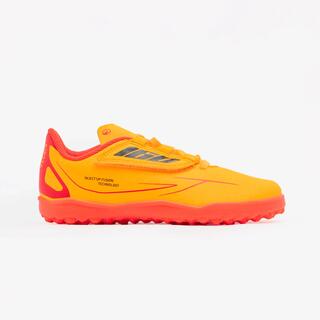


Turf, Firm Ground, and Indoor Court Outsole Engineering for Indian Playing Surfaces
Football shoes divide into three primary outsole architectures, each engineered for distinct surface friction coefficients and ground penetration mechanics. Turf (TF) outsoles feature high-density rubber nub arrays, typically 30 to 50 individual studs per sole, designed for artificial grass and hard-packed dirt pitches common across Indian municipal grounds. These multi-directional circular or conical studs measure 3 to 5mm in height, distributing pressure evenly to prevent excessive surface grip that could torque ankle joints during rapid directional changes. Firm ground (FG) configurations use 10 to 13 bladed or conical studs, each 10 to 13mm tall, engineered to penetrate natural grass and provide rotational traction on monsoon-softened fields. Indoor court (IC) shoes eliminate studs entirely, relying on flat gum rubber compounds with herringbone or circular tread patterns that grip polished concrete and synthetic indoor surfaces without leaving scuff marks.
Indian playing conditions demand specific outsole durability thresholds. Concrete-adjacent turf fields generate higher abrasion rates than European grass pitches, requiring outsole rubber compounds with Shore A hardness ratings between 60 and 70 for wear resistance. Decathlon's Kipsta brand engineers turf shoes with reinforced toe caps using thermoplastic polyurethane (TPU) overlays, critical for players who drag their dominant foot during shooting mechanics. The transition from monsoon humidity (80 to 90 percent relative humidity) to summer heat (40 to 45 degrees Celsius surface temperatures) also affects rubber compound flexibility, necessitating formulations that maintain grip elasticity across temperature extremes without hardening or softening excessively.
Upper Material Construction: Synthetic Microfiber vs Knit vs Leather for Ball Touch and Durability
Football shoe uppers balance three competing demands: ball contact sensitivity, structural support during lateral cuts, and long-term abrasion resistance. Synthetic microfiber polyurethane (PU) uppers, common in Kipsta Agility and Viralto models, use layered constructions with 0.8 to 1.2mm thickness. These materials provide consistent ball touch in wet conditions, critical during monsoon matches when natural leather absorbs water and gains 15 to 20 percent additional weight. Microfiber surfaces also accept textured embossing patterns that increase spin coefficient during instep passes and curve shots, with ridge heights typically 0.3 to 0.5mm for enhanced friction without sacrificing comfort.
Knit uppers, found in performance-tier models, use engineered circular knit polyester blends with 10 to 15 percent elastane for adaptive fit. These single-layer constructions reduce overall shoe weight by 20 to 40 grams compared to multi-layer synthetics, beneficial for attacking players prioritizing acceleration. However, knit durability suffers on abrasive Indian turf, where dragging movements during tackles can fray fibers within 40 to 60 hours of play. Full-grain leather uppers offer superior long-term durability and mold to foot shape over break-in periods of 8 to 12 sessions, but require consistent conditioning in high-humidity environments to prevent cracking. Kipsta positions leather options for players training 4 to 5 times weekly on natural grass, while synthetic and knit variants suit multi-surface athletes rotating between turf, concrete, and indoor courts.
Lacing Systems, Heel Counter Lockdown, and Midfoot Stability for Directional Change Mechanics
Effective football footwear must resist the biomechanical forces generated during cutting maneuvers, where ground reaction forces reach 2.5 to 3 times body weight and lateral shear stresses spike during 90 to 180-degree directional changes. Asymmetric lacing systems, offset 5 to 8mm toward the medial side, create expanded strike zones on the instep for cleaner ball contact during passes. These configurations also reduce pressure points over the dorsal foot, critical for players with high arches or prominent navicular bones. Heel counters use internal thermoplastic frames that wrap 180 to 220 degrees around the calcaneus, preventing rearfoot slippage that can cause blisters during 90-minute matches in 35-degree heat.
Midfoot stability derives from external cage structures or internal shank plates. TPU cages, visible on lateral and medial shoe walls, connect heel counters to forefoot flex grooves, creating torsional rigidity that resists excessive pronation during plant-and-cut sequences. Carbon fiber or nylon shanks, embedded between midsole and outsole layers, add 15 to 25 percent torsional stiffness without significantly increasing weight. Kipsta integrates these technologies selectively: entry-level models prioritize comfort with softer heel collars and flexible midfoot sections for recreational players, while advanced Agility and CLR ranges incorporate rigid stabilizers for competitive athletes executing high-frequency directional changes. Proper lockdown also depends on lace length and eyelet spacing. Six to seven eyelet pairs with 12 to 15mm vertical spacing allow progressive tension adjustment, with the top two eyelets angled 10 to 15 degrees outward to accommodate higher-volume feet without constricting the ankle joint.
Midsole Cushioning and Energy Return: EVA Density Gradients and Responsive Foam Platforms
Football involves intermittent high-impact landings from headers and aerial challenges, combined with sustained low-intensity jogging that accumulates fatigue over match duration. Midsole foams must attenuate peak impact forces while maintaining ground feel for precise ball manipulation. Dual-density EVA constructions use softer foam (Shore A 45 to 50) in heel crash pads to absorb initial contact forces, transitioning to firmer foam (Shore A 55 to 60) in forefoot sections that preserve energy return during toe-off propulsion. This gradient prevents excessive compression that would lower players closer to the ground, reducing leverage for shooting power.
Midsole stack heights in football shoes range from 8 to 12mm in the forefoot and 18 to 24mm in the heel, creating heel-to-toe drops of 8 to 12mm. Lower drops (8mm) suit players with strong calf flexibility who prefer midfoot or forefoot striking patterns, common among wingers and forwards prioritizing sprint speed. Higher drops (12mm) accommodate heel strikers and provide additional Achilles tendon relief for players returning from lower leg injuries. Kipsta models also incorporate EVA compression molding that increases foam density by 10 to 15 percent compared to injection-molded alternatives, improving durability on hard Indian surfaces where midsoles can bottom out after 80 to 100 hours of play. Responsive foam platforms, using supercritical EVA or polyurethane blends, add 8 to 12 percent energy return, measurable through rebound testing where foam returns to 55 to 60 percent of original height after compression, compared to 45 to 50 percent for standard EVA.
Kipsta Football Shoe Ranges: Agility, Viralto, CLR, and First Kick for Skill-Specific Performance
Kipsta segments football footwear into four primary collections, each targeting distinct playing styles and skill development stages. The Agility range prioritizes lightweight construction (220 to 260 grams per shoe in size UK 8) and aggressive stud configurations for attackers requiring maximum acceleration and cutting speed. Uppers use thin microfiber or knit materials with minimal padding, reducing break-in time to 2 to 3 sessions. Midsoles incorporate responsive foam with 10 to 12 percent energy return, beneficial for players making 40 to 60 sprints per match. Agility models suit competitive players training 3 to 5 times weekly on quality turf or grass surfaces.
Viralto positions as the versatile mid-tier option, balancing durability with performance across multiple surface types. These shoes use reinforced synthetic uppers with 1.0 to 1.2mm thickness, extending lifespan to 120 to 150 hours of play on abrasive Indian turf. Midsole cushioning increases slightly (22 to 26mm heel stack) for players who also use football shoes for recreational jogging or gym sessions. CLR (Classic) models emphasize traditional aesthetics and natural leather uppers for purists who value break-in comfort and long-term foot conformity. These shoes require 8 to 10 sessions to fully mold but offer superior durability for players training exclusively on natural grass. First Kick represents the entry-level collection, designed for youth players and beginners with simplified constructions, wider toe boxes to accommodate growing feet, and budget-conscious materials that still meet safety and traction standards for school and recreational leagues.
Sizing, Fit Profiles, and Break-In Protocols for Indian Foot Morphology and Climate Adaptation
Indian foot morphology trends toward slightly wider forefeet and higher arches compared to European lasts, requiring careful size selection in football shoes where snug fit is critical for ball control. Kipsta uses semi-curved lasts with forefoot widths 2 to 4mm broader than racing shoe lasts, accommodating natural toe splay during push-off without creating excess volume that causes midfoot slippage. Players should target 5 to 8mm of space between longest toe and shoe end when standing, as feet expand 3 to 5 percent in length and width during 90-minute matches due to heat and impact-induced swelling. This expansion accelerates in 35 to 40-degree ambient temperatures common during summer afternoon matches.
Break-in protocols vary by upper material. Synthetic microfiber shoes require minimal break-in, typically 1 to 2 training sessions of 60 to 90 minutes, during which players should focus on low-intensity passing drills to allow heel counters to conform without causing blisters. Leather uppers demand 8 to 12 sessions, with players initially wearing shoes for 30 to 45 minutes before switching to broken-in pairs. Applying leather conditioner after every 3 to 4 sessions prevents cracking in high-humidity monsoon conditions. Knit uppers adapt immediately but require tighter lacing to prevent stretch-induced looseness after 20 to 30 hours of play. For players between sizes, choosing the smaller size generally improves ball touch and prevents toenail trauma during deceleration, provided the forefoot width accommodates natural splay without compressing the fifth metatarsal. Kipsta also offers half sizes in popular models, critical for players with feet measuring between standard UK increments.
FAQ (Frequently Asked Questions)
Q1. What is the difference between turf (TF) and firm ground (FG) football shoes, and which works better on Indian municipal pitches?
Turf shoes use 30 to 50 short rubber studs (3 to 5mm height) designed for artificial grass and hard dirt, while firm ground shoes have 10 to 13 longer bladed studs (10 to 13mm) for natural grass penetration. Most Indian municipal and residential complex pitches use artificial turf or compacted dirt, making turf outsoles the better choice for consistent traction without excessive grip that could stress joints. Firm ground shoes work best on well-maintained natural grass fields during monsoon season when ground softens.
Q2. How long do Kipsta football shoes typically last when playing on abrasive Indian turf surfaces 3 to 4 times per week?
Synthetic microfiber models like Kipsta Viralto typically deliver 100 to 150 hours of play on abrasive turf before outsole studs wear below effective height or upper materials show significant abrasion. Leather models can extend to 150 to 200 hours with proper conditioning. Entry-level ranges may show wear at 60 to 80 hours. Durability depends heavily on playing style, with defenders who slide tackle frequently experiencing faster toe cap and medial side wear.
Q3. Should I choose synthetic or leather uppers for playing in high-humidity monsoon conditions?
Synthetic microfiber uppers perform better in monsoon humidity and rain, as they resist water absorption and maintain consistent weight and ball touch when wet. Leather absorbs moisture, gaining 15 to 20 percent weight and requiring 24 to 48 hours drying time between sessions. However, leather offers superior long-term durability and comfort for players training exclusively on natural grass in dry conditions. Synthetic suits multi-surface players and wet-weather reliability.
Q4. What size should I select if I am between UK 9 and UK 9.5, and my feet swell during long matches?
Choose UK 9.5 if your feet measure closer to 9.5 when standing and you experience significant swelling (noticeable tightness in current shoes after 60 minutes). Choose UK 9 if you measure closer to 9 and prioritize tight ball control, as feet naturally expand 3 to 5 percent during play. Ensure 5 to 8mm toe space when standing. Kipsta offers half sizes in most ranges, making precise fitting achievable without compromising performance or comfort during 90-minute matches.
Q5. Can I use turf football shoes for indoor futsal on concrete or wooden courts?
Turf shoes work on indoor concrete surfaces but are not ideal for polished wood or synthetic indoor courts. The rubber studs on turf outsoles can reduce lateral grip on smooth indoor surfaces and may leave marks on gymnasium floors. Indoor court (IC) shoes with flat gum rubber outsoles and herringbone tread patterns provide better traction and court compatibility. If playing mixed venues, turf shoes offer acceptable compromise for concrete and artificial grass but underperform compared to dedicated IC shoes indoors.
Q6. How do I break in new Kipsta leather football shoes without getting blisters during the first few training sessions?
Wear new leather shoes for 30 to 45 minutes during initial sessions, focusing on passing and low-intensity drills before switching to broken-in pairs. Apply leather conditioner before first use and after every 3 to 4 sessions to maintain suppleness in humid conditions. Use moisture-wicking socks and consider blister prevention tape on known hot spots (heel, fifth toe). Full break-in requires 8 to 12 sessions as leather molds to foot shape, after which comfort and fit improve significantly compared to synthetic alternatives.
Q7. What heel-to-toe drop should I look for if I have tight calves or a history of Achilles discomfort?
A higher heel-to-toe drop of 10 to 12mm reduces strain on the Achilles tendon by decreasing the angle of dorsiflexion required during the stance phase. This configuration suits players with limited ankle mobility or those returning from lower leg issues. Lower drops (8mm) require greater calf flexibility and suit players with strong posterior chain strength. Kipsta Viralto and CLR ranges typically offer 10 to 12mm drops, while Agility models use 8 to 10mm for performance-oriented players with adequate flexibility.
Q8. Do Kipsta football shoes run narrow or wide compared to other brands, and how does this affect players with broader forefeet?
Kipsta uses semi-curved lasts that are 2 to 4mm wider in the forefoot compared to narrow European racing lasts, accommodating Indian foot morphology better than some international brands. Players with wide forefeet (E width or broader) should still try shoes before purchasing, as football shoes intentionally fit snugger than running shoes for ball control. Models with knit uppers offer more adaptive stretch, while synthetic microfiber provides structured width. If between sizes, choosing the larger size and using tighter lacing often works better than forcing wide feet into narrow constructions.
Q9. How often should I replace football shoes if I play competitive matches once a week plus two training sessions?
At three sessions per week (approximately 4 to 5 hours total play time), quality synthetic models should last 25 to 35 weeks (100 to 150 hours) before outsole wear or midsole compression affects performance. Leather models may extend to 35 to 45 weeks with proper care. Replace shoes when studs wear below 50 percent original height, midsole cushioning feels flat (no rebound), or upper materials show structural tears. Rotating between two pairs extends individual shoe lifespan by allowing midsole foams to fully recover between sessions.
Q10. What maintenance steps help Kipsta football shoes last longer when playing on dusty Indian turf and storing in humid conditions?
Remove loose dirt with a dry brush immediately after play, then wipe uppers with a damp cloth to prevent dust abrasion. Stuff shoes with newspaper to absorb moisture and maintain shape, replacing paper after 12 hours. Store in ventilated areas away from direct sunlight, as UV exposure degrades adhesives and synthetic materials. For leather models, apply conditioner every 3 to 4 sessions to prevent cracking. Never machine wash or use direct heat for drying, as this breaks down midsole foams and weakens upper stitching. Clean outsoles with mild soap to maintain rubber grip properties.