Rods
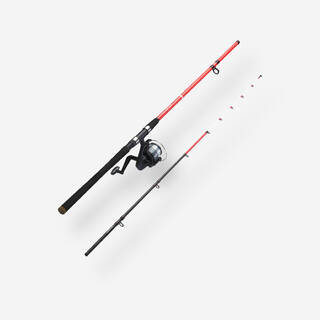
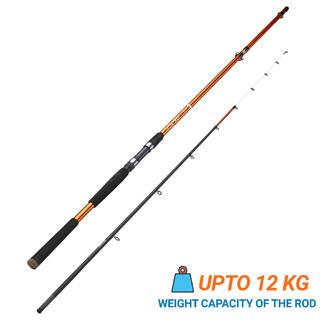
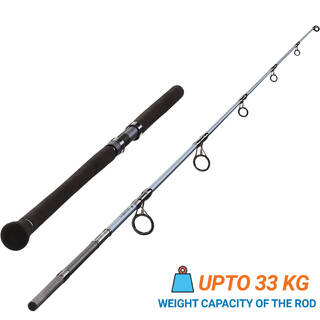
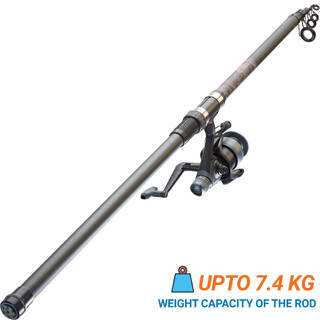
Carbon vs Fiberglass Composite Blank Construction for Indian Freshwater and Coastal Conditions
Fishing rod blank material directly governs casting distance, sensitivity to strike detection, and durability under high-humidity monsoon storage. Carbon fiber blanks, measured by modulus ratings (IM6, IM7, IM8), deliver superior sensitivity for detecting subtle nibbles in murky reservoir water or tidal creek channels. Higher modulus carbon (IM8 and above) transmits vibrations faster, critical when fishing with soft plastics or finesse rigs in shallow backwaters where visibility is low. Fiberglass blanks offer greater flex and forgiveness, ideal for beginners learning casting mechanics on hard concrete embankments or rocky shorelines where accidental impacts are common.
Composite rod blanks blend carbon and fiberglass layers to balance sensitivity with impact resistance. This hybrid construction suits Indian anglers targeting aggressive species like murrel, catfish, or barramundi in snag-heavy environments with submerged logs, root systems, or rocky substrates. The outer carbon layer maintains strike sensitivity while the inner fiberglass core absorbs shock loads during aggressive hooksets. Blank wall thickness, measured in millimeters at the butt section, determines load-bearing capacity for heavy lures (20 to 40 grams) used in reservoir trolling or surf casting along the Konkan and Coromandel coasts.
Rod taper profiles (fast, moderate-fast, moderate, slow) control power distribution from tip to butt. Fast-action rods bend primarily in the upper third, concentrating power for long-distance casting with weighted jigs or spoons. Moderate-action rods distribute flex across the middle section, providing cushioning for light monofilament lines (4 to 8 lb test) when targeting panfish or tilapia in urban lakes. Slow-action rods bend throughout the entire blank, ideal for absorbing sudden runs from powerful carp or mahseer in flowing river currents where rod flex prevents line breakage during extended fights.
Casting Weight Ratings and Line Class Matching for Reservoir, River, and Saltwater Applications
Casting weight ratings, expressed in grams, define the optimal lure weight range for achieving maximum casting distance without overloading the blank. Light-action rods (2 to 10 grams) suit finesse techniques with small crankbaits, spinners, or soft plastic worms in shallow ponds and irrigation canals where fish pressure is high. Medium-action rods (10 to 30 grams) handle versatile applications from jigging in deep reservoir structures to casting topwater poppers along mangrove-lined tidal creeks. Heavy-action rods (30 to 80 grams) provide backbone for trolling deep-diving plugs in large impoundments or casting metal jigs through surf zones during monsoon pelagic runs.
Line class recommendations, printed on the blank near the reel seat, ensure balanced system performance. Pairing a 10 to 20 lb line class rod with 30 lb braided line creates imbalance, reducing casting accuracy and increasing blank stress during hooksets. Monofilament lines stretch 15 to 25 percent under load, providing shock absorption for light-action rods when fighting fish in open water. Braided lines offer zero stretch, transmitting every vibration directly to the angler's hand, essential for detecting bottom structure changes or subtle strikes in deep water (15 to 30 meters) where visual cues are absent.
Power ratings (ultra-light, light, medium, medium-heavy, heavy) describe the force required to bend the rod blank under load. Medium-heavy power rods generate sufficient backbone for extracting snook or trevally from rocky jetties or pier pilings where fish dive into structure immediately after hookup. Ultra-light power rods flex under minimal pressure, designed for micro-jigging in clear mountain streams or targeting small barbs and danios in shallow riffles where delicate presentations prevent spooking wary fish.
Guide Ring Material Science: Ceramic, Silicon Carbide, and Stainless Steel Friction Coefficients
Guide ring material directly impacts casting distance through friction reduction and heat dissipation during high-speed line release. Silicon carbide (SiC) guides offer the lowest friction coefficient (0.02 to 0.04), allowing braided lines to flow smoothly during long casts without generating heat that weakens line integrity. Ceramic oxide guides provide moderate friction resistance, suitable for monofilament or fluorocarbon lines where heat buildup is less critical. Stainless steel guides, common on entry-level rods, create higher friction but withstand saltwater corrosion better than uncoated ceramic rings in coastal environments.
Guide frame construction uses stainless steel, titanium, or anodized aluminum to secure the ceramic insert. Single-foot guides reduce overall rod weight, enhancing sensitivity for detecting light strikes, while double-foot guides distribute stress across a wider blank area, critical for heavy-action rods subjected to repeated high-load casting. Guide spacing follows mathematical distribution patterns, with closer spacing near the tip (40 to 60 mm intervals) to control line sag and wider spacing near the butt (120 to 180 mm intervals) to accommodate larger line loops during casting acceleration.
Fuji guide systems, recognized by model codes (K-series, KL-series, KR-series), represent industry benchmarks for durability and performance. K-series guides use stainless steel frames with Alconite or SiC inserts, balancing cost with corrosion resistance for freshwater applications. KR-series guides employ titanium frames that reduce weight by 40 to 50 percent compared to stainless steel, improving rod balance for all-day casting sessions in reservoir boats or surf zones. Guide insert diameter, measured in millimeters, must match line diameter and casting style, with larger inserts (10 to 16 mm tip guides) accommodating thicker braided lines without friction choking during release.
Cork vs EVA Grip Ergonomics and Reel Seat Locking Mechanisms for Extended Fishing Sessions
Handle grip material affects palm comfort, moisture management, and tactile feedback during extended casting sessions in high-humidity monsoon conditions. Natural cork grips, graded A through C quality, absorb hand sweat while maintaining non-slip texture even when wet. Premium AAA-grade cork uses dense, uniform cells that resist compression over thousands of casting cycles, critical for tournament anglers fishing 8 to 12 hour sessions. EVA foam grips offer superior durability in saltwater environments where cork degradation from salt crystallization becomes problematic after repeated exposure without freshwater rinsing.
Split-grip handle designs reduce overall rod weight by removing material between the reel seat and butt cap, improving balance for single-handed casting techniques. Full-length grips provide two-handed leverage for heavy-action rods used in surf casting or deep jigging where maximum casting distance (60 to 80 meters) requires coordinated upper and lower hand movements. Rear grip length, measured from reel seat to butt cap (200 to 350 mm), determines leverage arm length for loading the rod blank during the casting stroke, with longer rear grips generating higher tip speeds for distance casting.
Reel seat locking mechanisms use threaded hoods (uplocking or downlocking) to secure spinning or baitcasting reels. Uplocking seats position the locking hood above the reel foot, concentrating weight closer to the angler's hand for improved balance during retrieval. Downlocking seats place the hood below the reel foot, providing a lower center of gravity preferred for bottom fishing or vertical jigging where rod tip control matters more than casting distance. Graphite reel seats reduce weight but lack the durability of anodized aluminum seats subjected to frequent reel changes or accidental drops on concrete boat ramps and rocky shorelines.
One-Piece vs Multi-Piece Travel Rod Portability and Structural Integrity Trade-Offs
One-piece rod construction eliminates ferrule joints, maximizing blank sensitivity and power transmission from butt to tip. The continuous carbon fiber layup maintains uniform flex characteristics without dead spots caused by ferrule interruptions. One-piece rods suit anglers with dedicated vehicle storage or boat rod lockers, common among reservoir bass anglers or coastal surf casters who transport gear in trucks or SUVs with roof racks. The absence of connection points reduces failure risk during high-stress fights with large fish, critical when targeting trophy mahseer in Himalayan rivers or giant trevally in Lakshadweep atolls.
Two-piece rods use spigot or over-ferrule joints to separate the blank into equal or unequal sections for transport. Spigot ferrules insert a solid carbon plug from one section into the hollow section of the mating piece, maintaining 85 to 90 percent of one-piece rod sensitivity. Over-ferrules slide one section over the outside of the mating section, creating a stronger joint but slightly increasing weight at the connection point. Modern ferrule design uses precise machining tolerances (0.05 to 0.1 mm) to eliminate wobble or separation during casting, with alignment dots ensuring consistent guide positioning after assembly.
Four-piece and six-piece travel rods collapse to 50 to 70 cm lengths, fitting inside airline carry-on luggage or motorcycle panniers for remote fishing expeditions. Multi-piece blanks sacrifice 5 to 10 percent sensitivity compared to one-piece designs due to multiple ferrule interruptions, but advances in mandrel technology and resin systems have narrowed this performance gap. Pack rods suit trekkers accessing high-altitude Himalayan streams, island-hopping saltwater anglers, or urban fishermen using public transportation to reach fishing spots. Protective rod tubes with foam inserts prevent ferrule damage during transit, essential for maintaining joint integrity over repeated assembly cycles.
Caperlan Freshwater and Saltwater Rod Specifications for Indian Species and Environments
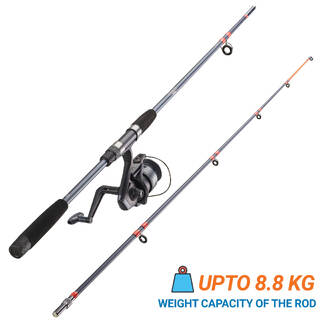
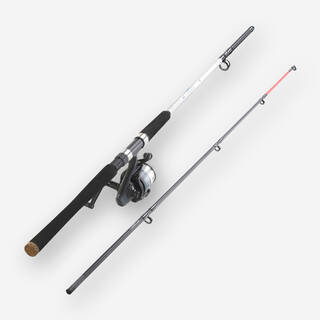
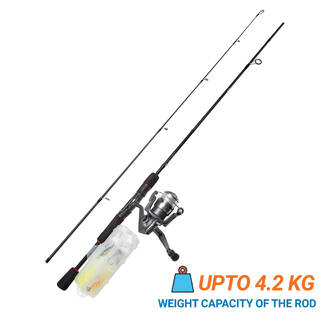
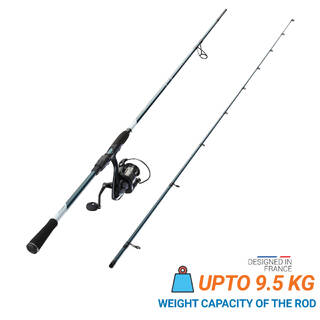
Caperlan designs fishing rods specifically for diverse Indian angling conditions, from Himalayan trout streams to coastal pelagic zones. Freshwater spinning rods in the 1.8 to 2.4 meter range target reservoir species like catla, rohu, and murrel using medium-action blanks that balance casting distance with fish-playing capability. These rods pair with 2000 to 3000 size spinning reels loaded with 8 to 12 lb monofilament, ideal for casting crankbaits, spinnerbaits, or live bait rigs in depths ranging from 2 to 10 meters. Rod lengths between 2.1 and 2.4 meters provide optimal leverage for boat fishing in large impoundments where long casts reach submerged structures or weed lines holding predatory fish.
Saltwater spinning rods extend to 2.7 to 3.6 meters for surf casting and rock fishing along the Arabian Sea and Bay of Bengal coastlines. Heavy-action blanks with 30 to 80 gram casting weights handle metal jigs, poppers, and cut bait rigs targeting trevally, queenfish, barracuda, and snapper. Stainless steel guide frames with SiC inserts resist saltwater corrosion during monsoon fishing sessions where rods remain exposed to salt spray for hours. Extended butt sections (300 to 400 mm) provide leverage for two-handed casting, generating tip speeds necessary to achieve 70 to 90 meter casting distances through onshore winds common during pre-monsoon and post-monsoon fishing windows.
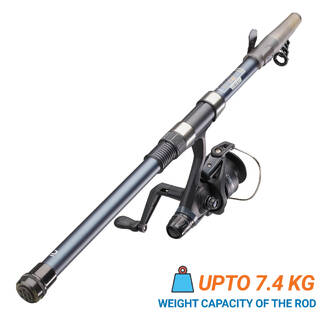
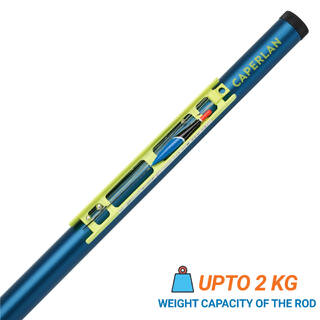
Telescopic rods collapse to compact lengths (40 to 60 cm) for portability, using nested blank sections that extend and lock via friction-fit joints. These designs suit urban anglers traveling by metro or bus to city lakes and canals, where rod length restrictions apply on public transport. Telescopic construction sacrifices some sensitivity compared to multi-piece spigot designs but offers unmatched convenience for spontaneous fishing trips. Caperlan telescopic models include pre-rigged options with line, float, and hook assemblies for immediate deployment, targeting beginners learning basic float fishing techniques for panfish and small carp in shallow ponds and irrigation tanks.
FAQ (Frequently Asked Questions)
Q1. What rod length works best for reservoir fishing from boats versus shore casting in Indian lakes?
Boat fishing in reservoirs requires 1.8 to 2.1 meter rods for maneuverability in confined spaces and accurate casting to visible structures like submerged trees or rock piles. Shore casting demands 2.4 to 2.7 meter rods to achieve distance (40 to 60 meters) needed to reach deeper water channels or weed edges beyond shallow littoral zones. Longer rods also provide better line control when fishing from elevated banks or concrete embankments common around Indian reservoirs.
Q2. How do I choose between carbon and fiberglass rods for murrel and catfish fishing in weedy backwaters?
Fiberglass or composite rods offer better durability when fishing heavy cover with thick vegetation and submerged obstacles where rod tips contact branches or roots during retrieval. Carbon rods provide superior sensitivity for detecting subtle strikes in murky water but require careful handling to avoid tip breakage. For aggressive species like murrel that strike hard and dive into weeds, choose medium-heavy power composite rods (20 to 40 gram casting weight) that combine sensitivity with the backbone needed to extract fish from dense cover.
Q3. What casting weight rating should I select for lure fishing in Himalayan rivers targeting mahseer and trout?
Trout fishing in mountain streams requires ultra-light to light-action rods (2 to 10 grams) for casting small spinners, spoons, and soft plastics in clear, shallow water where fish spook easily. Mahseer fishing in larger Himalayan rivers demands medium-heavy to heavy-action rods (30 to 80 grams) capable of handling large spoons, jigs, and live bait rigs in strong currents. The heavier power rating provides backbone to control powerful mahseer that run downstream into rapids after hookup.
Q4. Do I need different rods for freshwater and saltwater fishing, or can one rod handle both environments?
Saltwater rods require corrosion-resistant components including stainless steel or titanium guide frames, sealed reel seats, and EVA grips that withstand salt exposure without degrading. Freshwater rods can use standard stainless steel hardware and cork grips. While some medium-heavy freshwater rods physically handle saltwater species, repeated saltwater use without thorough freshwater rinsing causes corrosion in guides and reel seats, reducing lifespan. Dedicated saltwater rods with proper coatings and sealed components last significantly longer in coastal environments.
Q5. How does rod action (fast, moderate, slow) affect hookset success and fish landing rates?
Fast-action rods concentrate flex in the tip section, providing immediate hooksets critical for single-hook lures like jigs or soft plastics where quick wrist snaps drive hooks through tough jaw tissue. Moderate-action rods distribute flex across the middle section, cushioning sudden head shakes and preventing hook pullouts when using treble-hooked crankbaits or topwater plugs. Slow-action rods bend throughout the blank, ideal for light lines (4 to 8 lb test) where rod flex absorbs shock during fish runs, reducing line breakage with species like carp that make long, powerful surges.
Q6. What is the advantage of multi-piece travel rods compared to one-piece rods for fishing remote locations?
Multi-piece rods (four-piece or six-piece) collapse to 50 to 70 cm, fitting inside backpacks, motorcycle panniers, or airline carry-on luggage for accessing remote Himalayan streams, island fishing spots, or forest reservoirs unreachable by vehicle. One-piece rods require dedicated vehicle transport with roof racks or truck beds. Modern multi-piece designs using precision spigot ferrules retain 85 to 90 percent of one-piece sensitivity, making performance trade-offs minimal for most fishing applications.
Q7. How do I match rod power and line class for fishing in snag-heavy environments with submerged structures?
Snag-heavy environments require medium-heavy to heavy power rods paired with 15 to 30 lb braided line to extract fish before they reach cover. The stiff backbone prevents fish from diving into roots, rocks, or submerged logs immediately after hookup. Braided line's zero-stretch properties transmit power directly to the rod blank, allowing anglers to apply maximum pressure without line elongation absorbing force. This combination suits reservoir fishing around submerged timber or coastal rock fishing where structure contact is unavoidable.
Q8. What maintenance steps prevent rod damage during monsoon storage in high-humidity conditions?
Store rods in vertical positions or suspended horizontally to prevent blank warping from prolonged contact pressure. Loosen ferrule joints on multi-piece rods to prevent moisture-induced corrosion that causes stuck connections. Wipe guides and reel seats with freshwater after each use, then apply thin silicone lubricant to metal components. Store rods in breathable cloth bags rather than sealed plastic tubes to allow moisture evaporation. Cork grips benefit from light sanding with fine-grit paper (400 to 600 grit) annually to remove embedded dirt and restore texture.
Q9. Can I use spinning rods for baitcasting reels, or do reel types require specific rod designs?
Spinning rods mount reels underneath the blank with large guides to accommodate line spiraling off the spool, while baitcasting rods mount reels on top with smaller guides positioned for straight-line flow. Guide size, spacing, and orientation differ significantly between designs. Using a baitcasting reel on a spinning rod causes line friction, reduced casting distance, and potential guide damage. Always match reel type to rod design, with spinning rods for spinning reels and casting rods for baitcasting or conventional reels.
Q10. What rod specifications work best for surf casting along Indian coastlines during monsoon pelagic fish runs?
Surf casting requires 3.0 to 3.6 meter heavy-action rods with 40 to 100 gram casting weights to achieve 70 to 100 meter distances through onshore winds and breaking waves. Long rear grips (350 to 450 mm) provide leverage for two-handed casting strokes that generate high tip speeds. Pair with 5000 to 8000 size spinning reels loaded with 30 to 50 lb braided line for targeting trevally, queenfish, and barracuda in surf zones. Stainless steel or titanium guide frames resist saltwater corrosion during extended sessions in wave spray and tidal splash zones.